ESL
The Last Mile of Food SecurityPresentation · 23 slides · Caribbean Week of Agriculture 2026, Thursday 1 October
Film and session summary
Slide 1 of 23#

The Last Mile of Food Security

Using the region's new data tools to lower the food-import bill by capturing more value from the farm

Caribbean Week of Agriculture 2026 · The New F.A.C.E. of Caribbean Food Systems: Transformation and Resilience Ocean Coral Springs, Trelawny · Environmental Solutions Limited
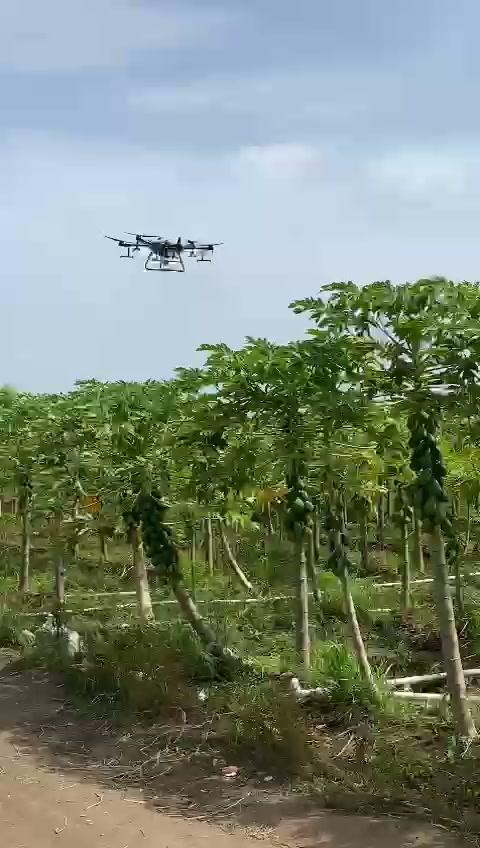
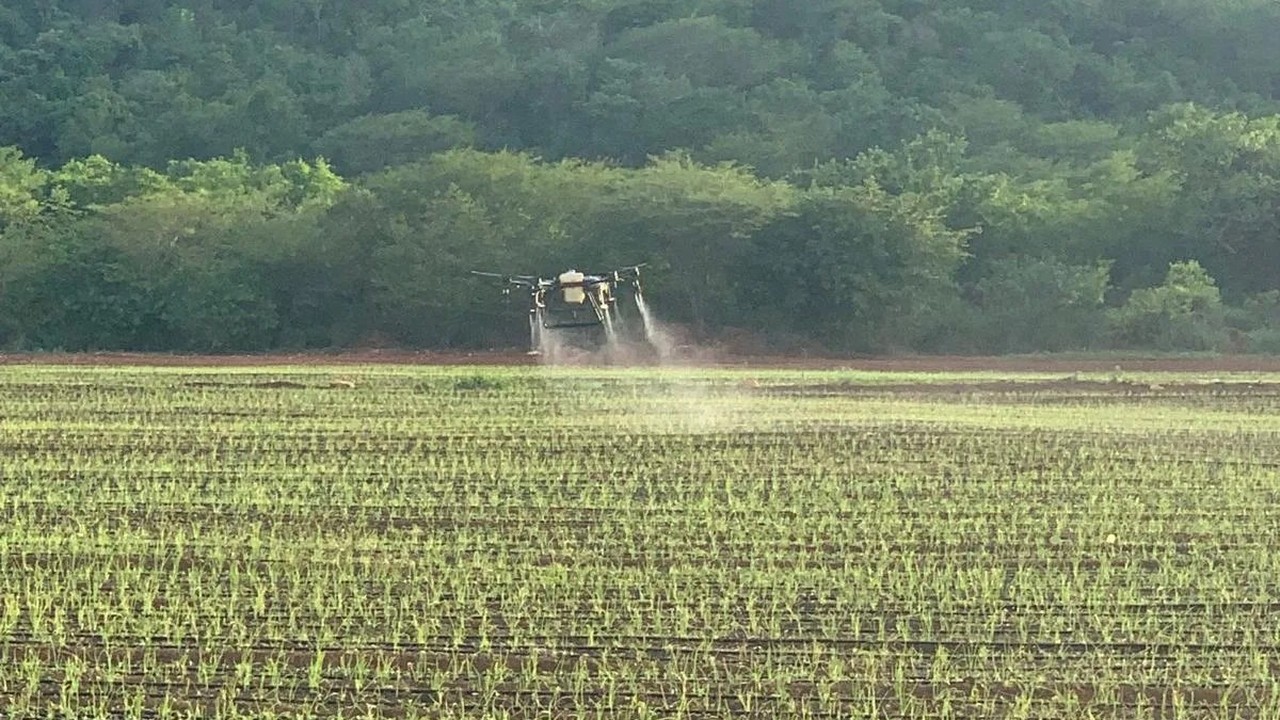
ESL spray-drone operations, Jamaica (2022)
1
Slide 2 of 23#

For the first time, the region has eyes

  • CARICOM–WFP Caribbean Real-Time Food Security Monitoring Dashboard: live since 10 April 2025 in 11 member states
  • Regional Risk Analysis, the E-Agriculture Strategy and the Pre-Clearance Mechanism for Goods: agreed at the 121st Special COTED on Agriculture (2 Oct 2025, CWA 2025)
  • Precision agriculture and digital skills are named E-Agriculture pillars

CWA 2026 is the first time these exist as agreed regional frameworks, now needing implementation.
Source: CARICOM (Apr 2025); CARICOM, 121st Special COTED (Oct 2025).
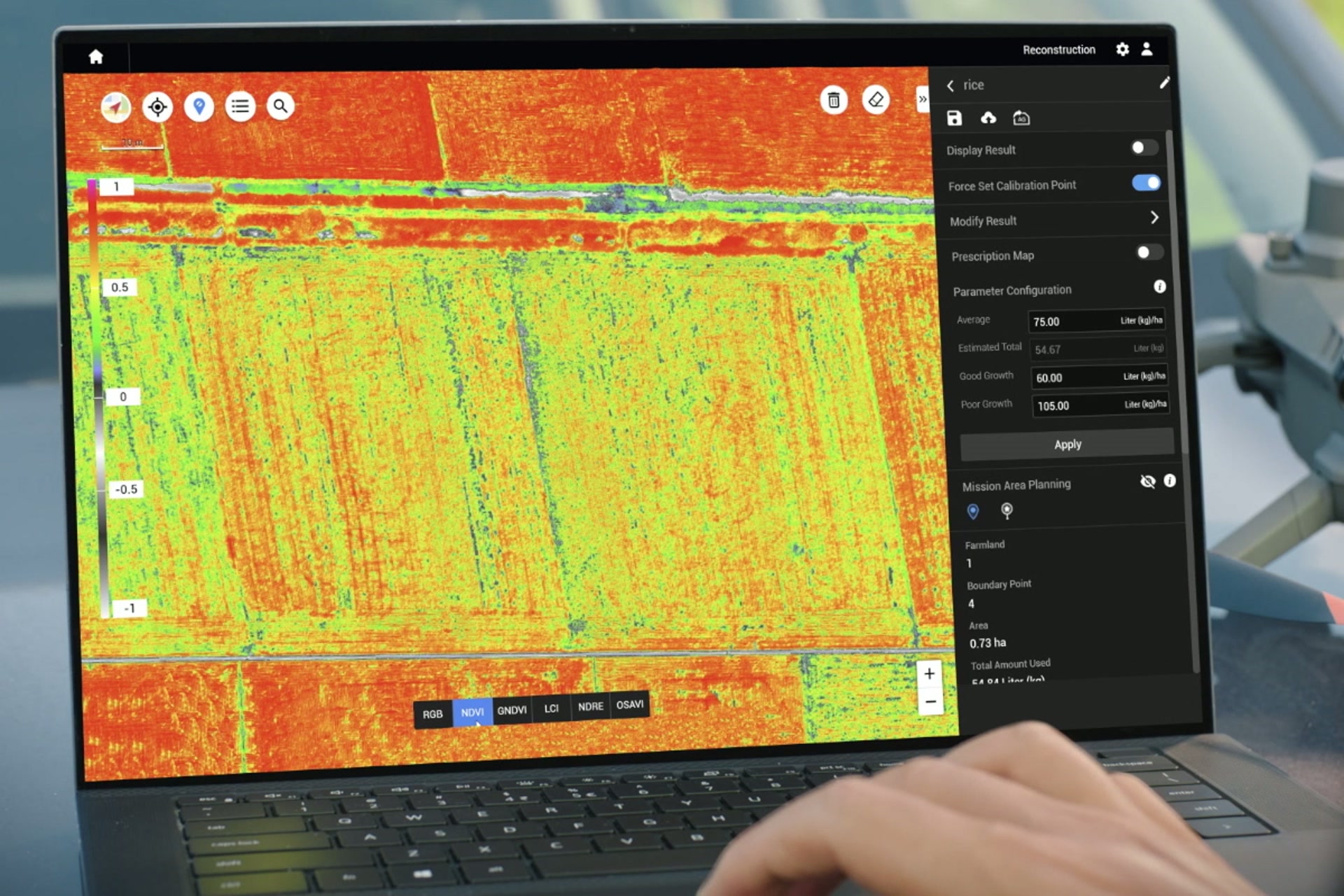
Crop-health map (DJI Agriculture)
2
Slide 3 of 23#

Production rose. The bill held.

  • CARICOM reports regional food production up about 24%, 2022 to late 2024
  • The regional food-import bill is still more than US$6 billion a year
  • The 25% reduction target moved from 2025 to 2030
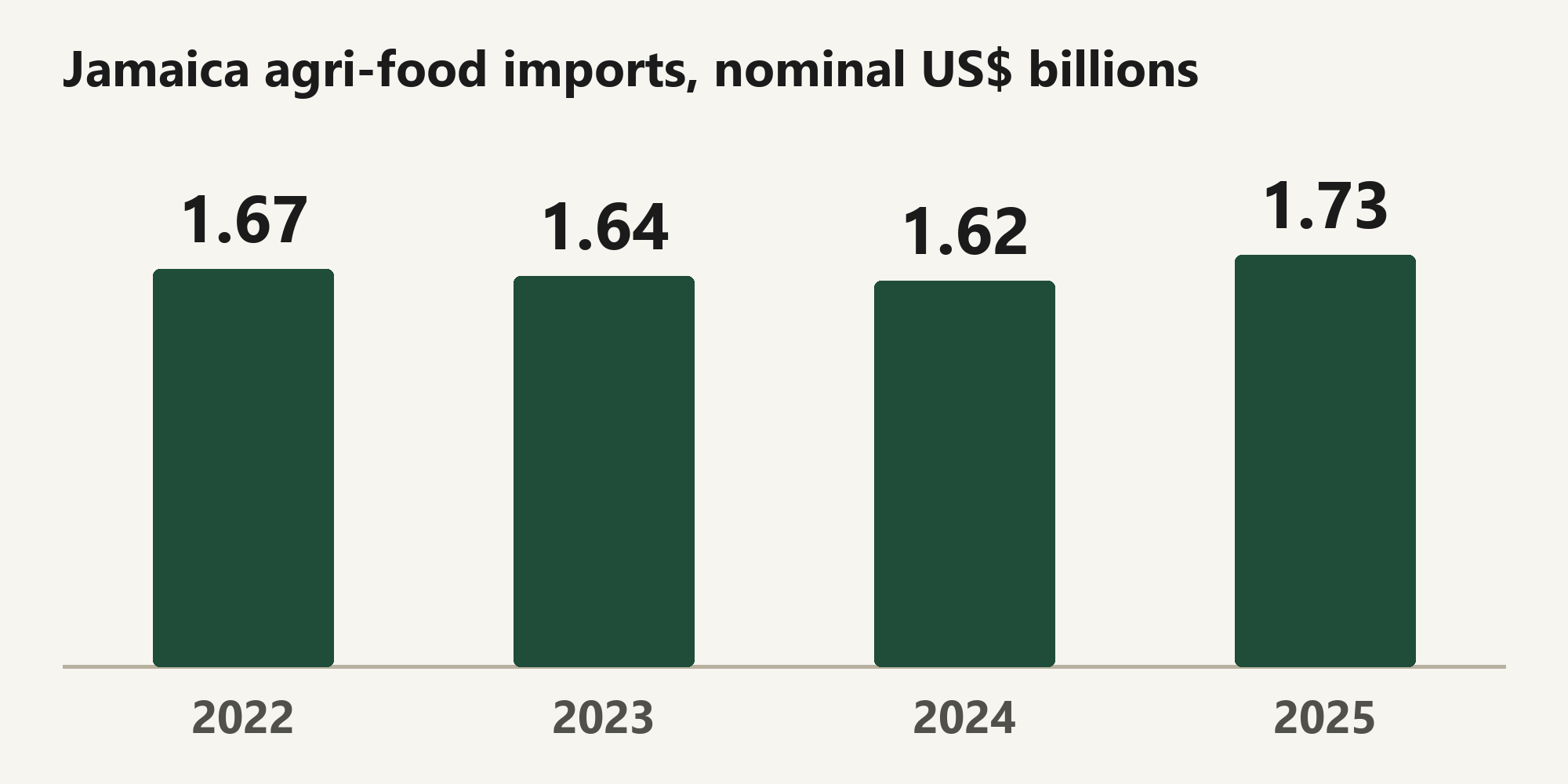
Jamaica agri-food imports, nominal US$ billions: 2022 1.67, 2023 1.64, 2024 1.62, 2025 1.73
Source: CARICOM Secretariat (Feb 2025); UN Comtrade.
3
Slide 4 of 23#

The bill follows world prices, not our fields
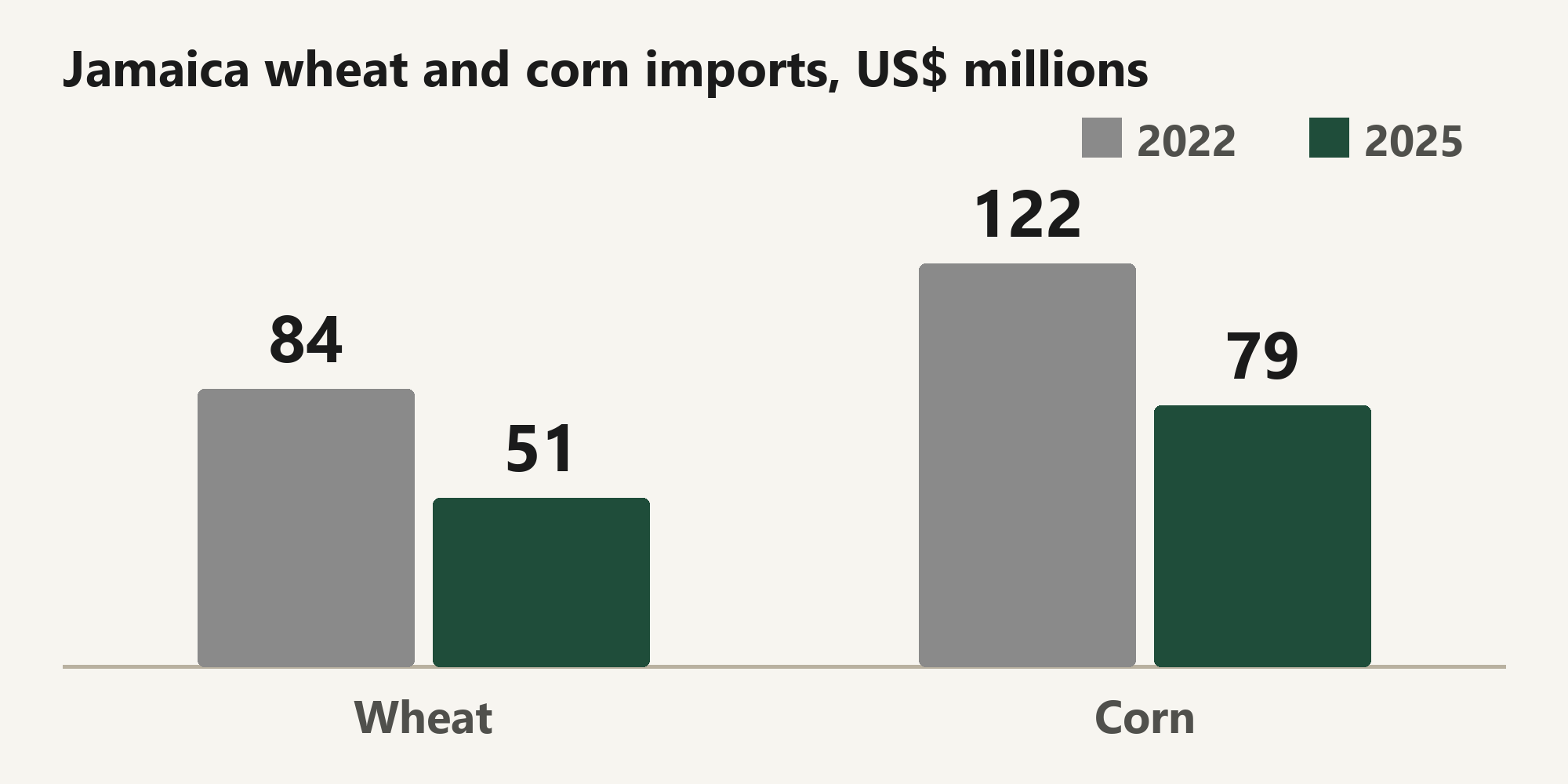
Jamaica wheat and corn imports, US$ millions: wheat 84 to 51, corn 122 to 79, 2022 vs 2025
  • Wheat: value US$84M → US$51M (~40% down); tonnes down only 8%
  • Corn: value US$122M → US$79M (35% down); tonnes down only 9%

Jamaica grows no wheat and very little corn. That US$76M fall came from world prices, not our farms.

We can't farm our way out of a grain bill. We can earn our way out of it.

Source: UN Comtrade (Jamaica, HS 1001, 1005).
4
Slide 5 of 23#

The winnable substitution is mostly won

  • Regional poultry output is heading for ~340,000 t, covering 80% of CARICOM's poultry consumption (2025)
  • Much of what's left is corn, soy, wheat and red meat: scale-driven commodities that most of our land can't grow competitively. Where the region can (Guyana's rice, corn and soy; Belize's beef), regional trade is the answer.
Source: Caribbean Poultry Association, 46th Board meeting (Oct 2025).
5
Slide 6 of 23#

Food security is a purchasing-power target

Not "How many tonnes did this acre produce?"

"How much of what this family eats did this acre pay for?"

A household is food-secure when the land it works generates enough value to command the food it consumes, whether it eats that food or sells what it grows and buys the rest.

A pepper turned into a finished product that earns an export premium funds far more imported nutrition than the same land in a staple it can never grow competitively.

6
Slide 7 of 23#

Floor and engine

Staples floor Value-add engine
Enough to eat through a hurricane or a closed border Enough value per acre to buy the rest
Protects against trade shocks Protects against local crop failure
Keeps you alive Keeps you solvent

Hurricane Melissa tested both. Real food security needs both.

7
Slide 8 of 23#

The last mile: from signal to the buyer's hands

Every mile before it (the region's data, the recovery investment, a farmer's whole season) is only worth what survives the last mile. And the last mile can't rescue a crop the earlier miles failed.

Climate and security act on every step. The records and test results that make the decision also travel with the produce.
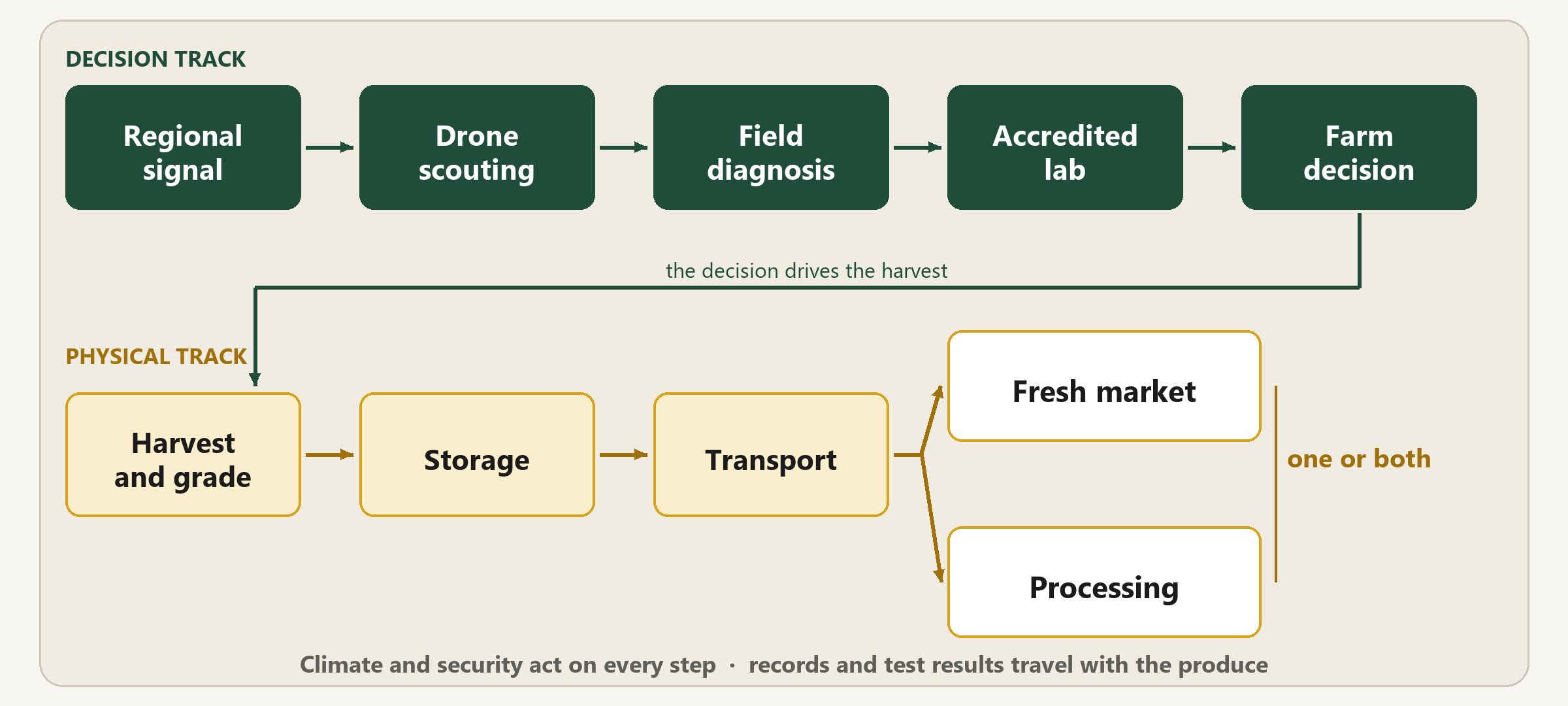
Two-track last-mile model: decision track above, physical track below forking to fresh market and/or processing
8
Slide 9 of 23#

Where value leaks after harvest

2026 reality What the last mile adds
Storage J$9.4bn Essex Valley agro-processing and cold-storage facility handed over (Feb 2026): capacity for 22 containers Grade and test before storage, so only sound produce takes up cold space
Transport 70 farm roads to be rehabilitated in 2026–27 after Melissa Harvest timed to buyer and road access; the records travel with the load
Security More than J$14 billion a year lost to agricultural theft; traceability is one of the Ministry's five response pillars Recorded, tested lots with provenance from farm to point of sale
Climate Production was heading for a record 930,000 t before Melissa hit 70,000+ farmers and fishers; drought followed in 2026 Signal-driven harvest, storage and processing decisions
Source: MoAFM and CDB (Feb 2026); JIS, post-Melissa agriculture strategy (2026); MoAFM, Minister of State Witter (11 Sep 2026); Gleaner (Aug–Sep 2026).
9
Slide 10 of 23#
Last mile · all six steps

The last mile

Signal → Drone → Ground truth → Lab → Decision → Value

10
Slide 11 of 23#

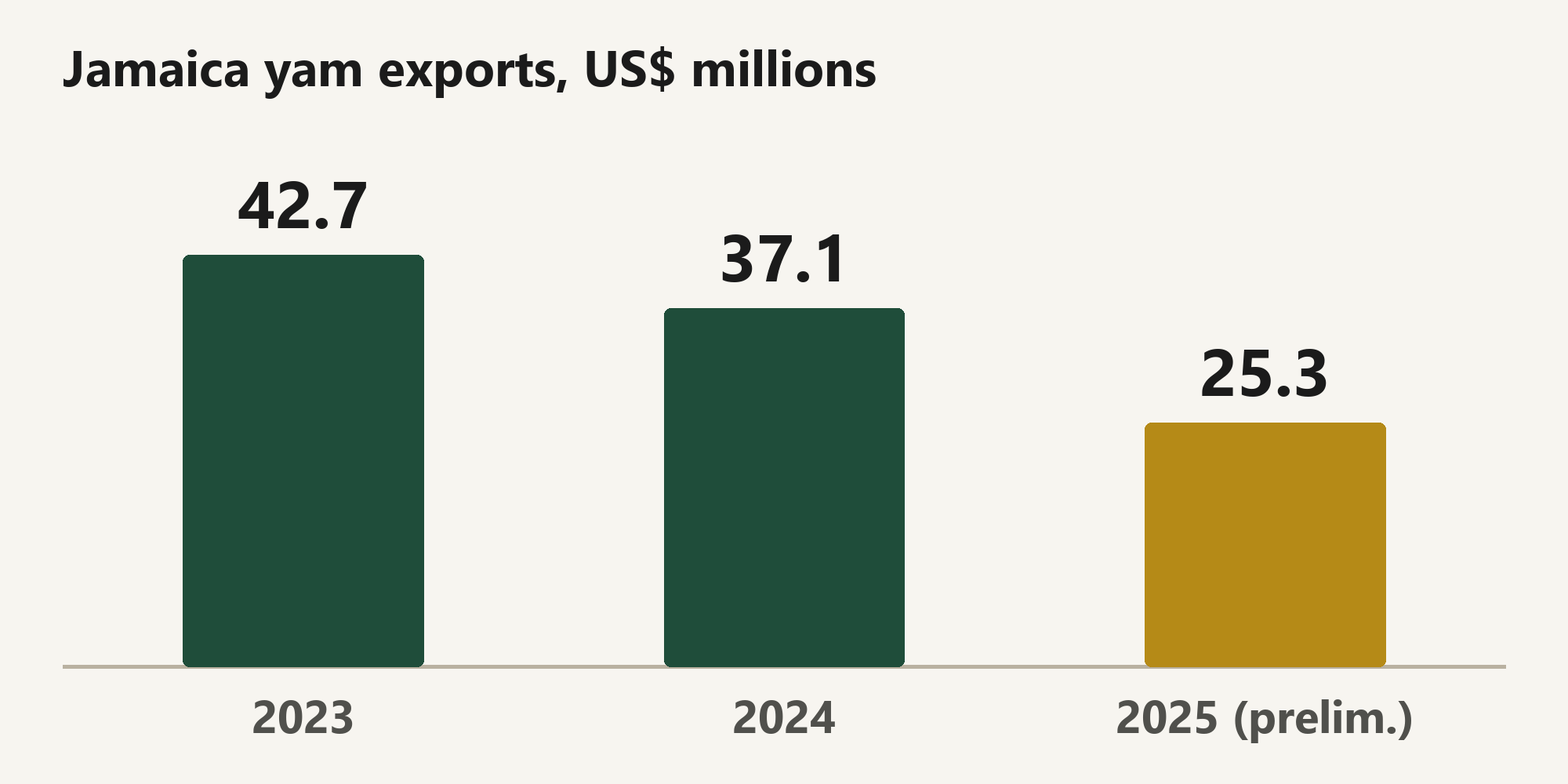
Yam: Trelawny's crop

Jamaica yam exports, US$ millions: 2023 42.7, 2024 37.1, 2025 preliminary 25.3
  • Jamaica's largest fresh-produce export
  • ~195,000 t produced (2024); almost all exports leave as fresh tubers
  • Trelawny is a top yam parish

Which tubers ship and which are lost is decided in the field, in the last mile.

Source: UN Comtrade (HS 071430); Gleaner (Mar 2026); Economic and Social Survey Jamaica.
11
Slide 12 of 23#

Rebuilding after Melissa: the 2026 recovery

  • J$100 million yam recovery programme across Trelawny, Manchester, Clarendon, St Ann, St James, Hanover and Westmoreland
  • 65,000 kg of yam heads (planting material) and fertiliser going out to farmers
  • J$40 million to revive hot pepper: 80,000 seedlings
  • More than 70,000 farmers hit by the storm; a recovery the Ministry calls data-driven

65,000 kg of planting material is going into the ground. Who checks it's clean? Who tells a farmer in time when a field goes wrong?
Source: Ministry of Agriculture, Fisheries and Mining (30 Apr 2026).
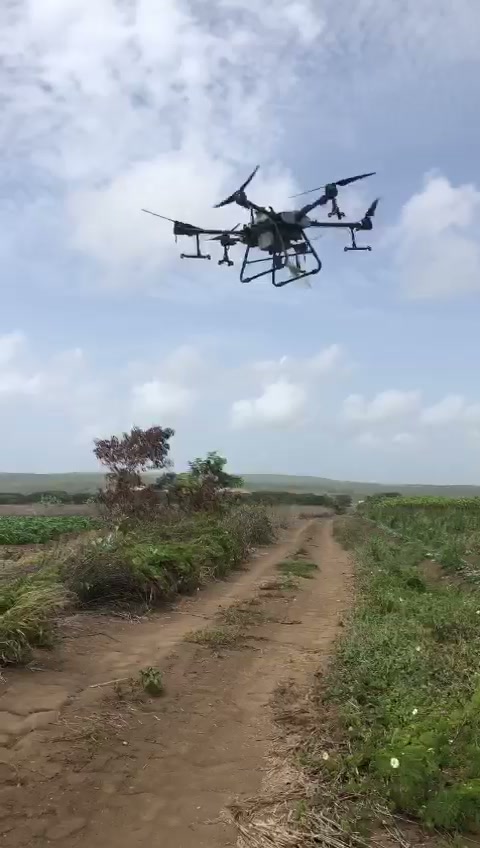
ESL spray-drone operations, Jamaica (2022)
12
Slide 13 of 23#
Last mile · Steps 1–3 of 6

Signal, drone, ground truth

  • The region publishes the signal: Jamaica is on agricultural drought watch to the end of September 2026
  • The drone finds where: which hills, which rows
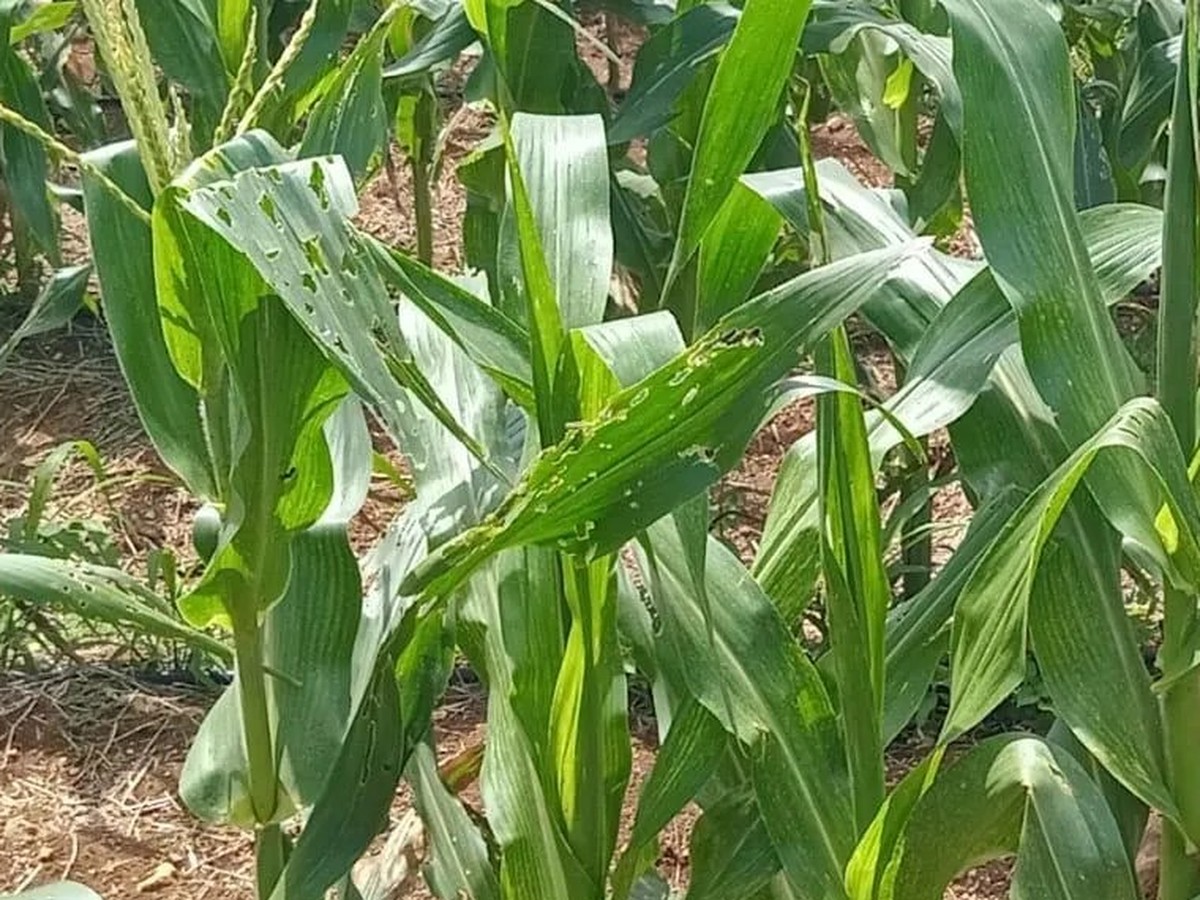
  • The scout confirms what: vines, a test dig, where the planting setts came from
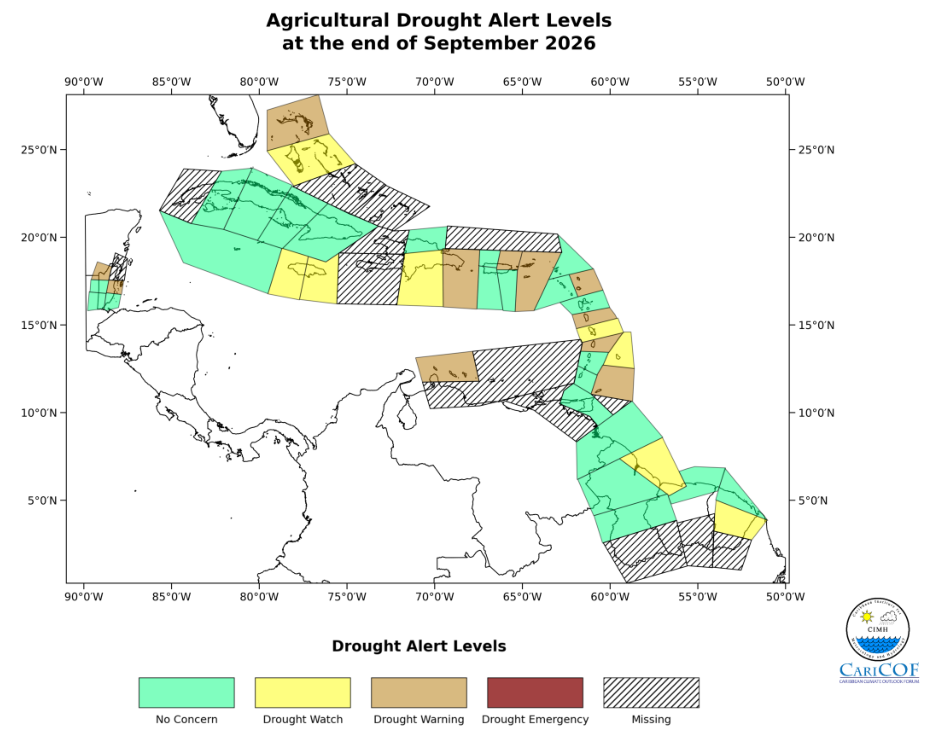
Source: CariCOF Drought Outlook, CIMH (Aug 2026).
Signal: Jamaica on drought watch
Drone: multispectral map finds where
Scout: pest damage confirmed on the ground
CariCOF / CIMH drought outlook (Aug 2026) · ESL bioTECH · ESL Farms sweet corn
13
Slide 14 of 23#
Last mile · Step 4 of 6

Laboratory confirmation

Test schedule

Test Why Against
Nematode screen of setts and soil "Yam burn" starts with infested planting material Presence and count
Fungicide residue on tubers Cut setts are treated before planting Importing country's limit (US tolerance / EU MRL)
Moisture, microbiology (processed products) Shelf life and buyer's certificate Buyer specification
Nutrition panel (processed products) Label claims Label rules
Aflatoxins, ochratoxin A, Salmonella (chilli powder) What export buyers test dried chilli for EU / US limits for spices [confirm]

Confirmation strong enough to act on, and a record an export buyer will accept. ESL's own pepper powder has just been through this: ESL and Bureau of Standards Jamaica analysis.

14
Slide 15 of 23#
Last mile · Step 5 of 6

The farm-level decision

Prepared for the extension officer:

  • Plant only screened setts; treat with a registered product at the label rate
  • Record the pre-harvest interval before harvest: stolen or rushed produce is often sold before it is safe
  • Grade at harvest: export-grade → fresh market; off-grade → processing; most farms will do both

The dashboard's signal, turned into an instruction a farmer can act on this week.
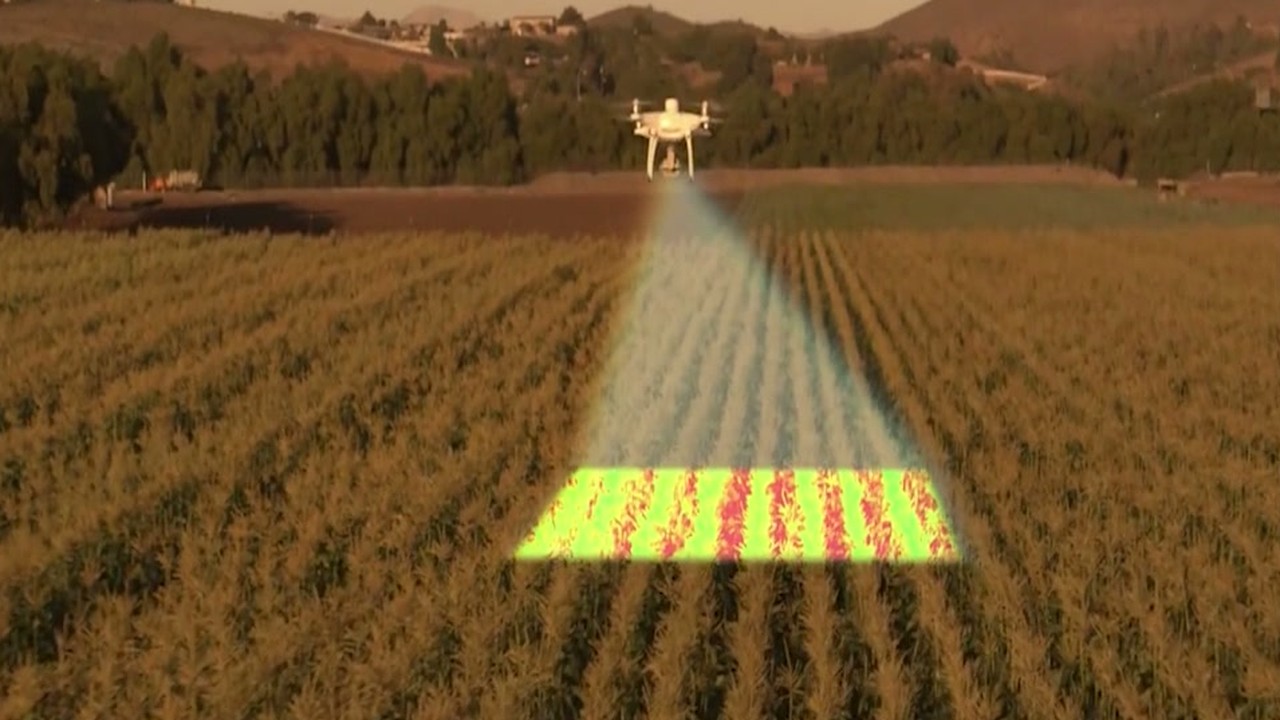
The drone goes only to the flagged patch
ESL spray drone treats the hotspot
ESL bioTECH · ESL spray-drone operations
15
Slide 16 of 23#
Last mile · Step 6 of 6

Capturing the value: fresh, processed, or both

After harvest and grading, the physical track forks:

  • Fresh market: export-grade yam earns its premium fresh, if storage and transport hold its quality
  • Processing: off-grade, cut, small and storm-damaged tubers become frozen peeled yam and 100% Jamaican yellow yam flour: gluten-free, traceable, tested
  • Both: most farms will run both paths from the same harvest. Processing turns what would be lost in storage or transport into product.

Several best-selling UK "pounded yam" powders are mostly potato. A tested Jamaican yam flour is a premium product in a market that already exists.

Source: product labels (UK retail).
16
Slide 17 of 23#
Last mile · proof

The last mile, already working on pepper

Step ESL Farms, Clarendon: Scotch bonnet and Moruga red
Signal In place
Drone scouting In place
Field diagnosis In place
Accredited lab Done: ESL and Bureau of Standards Jamaica analysis just completed
Farm decision In place
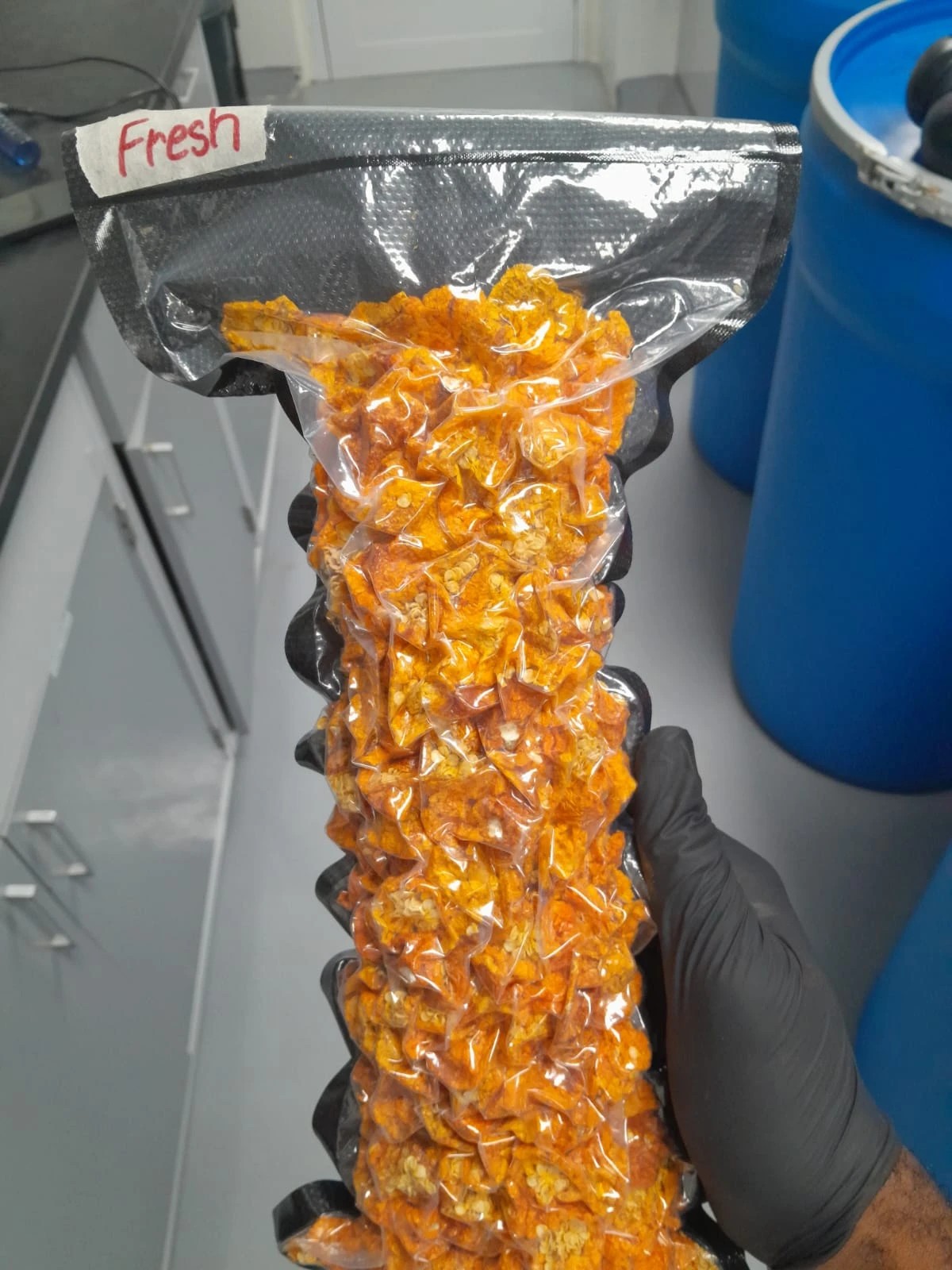
Value (processing path) Done: vacuum-packed powder; bulk-sale samples with buyers now

The Ministry is distributing 80,000 hot pepper seedlings to farmers in 2026. The last mile is what turns that crop into this.
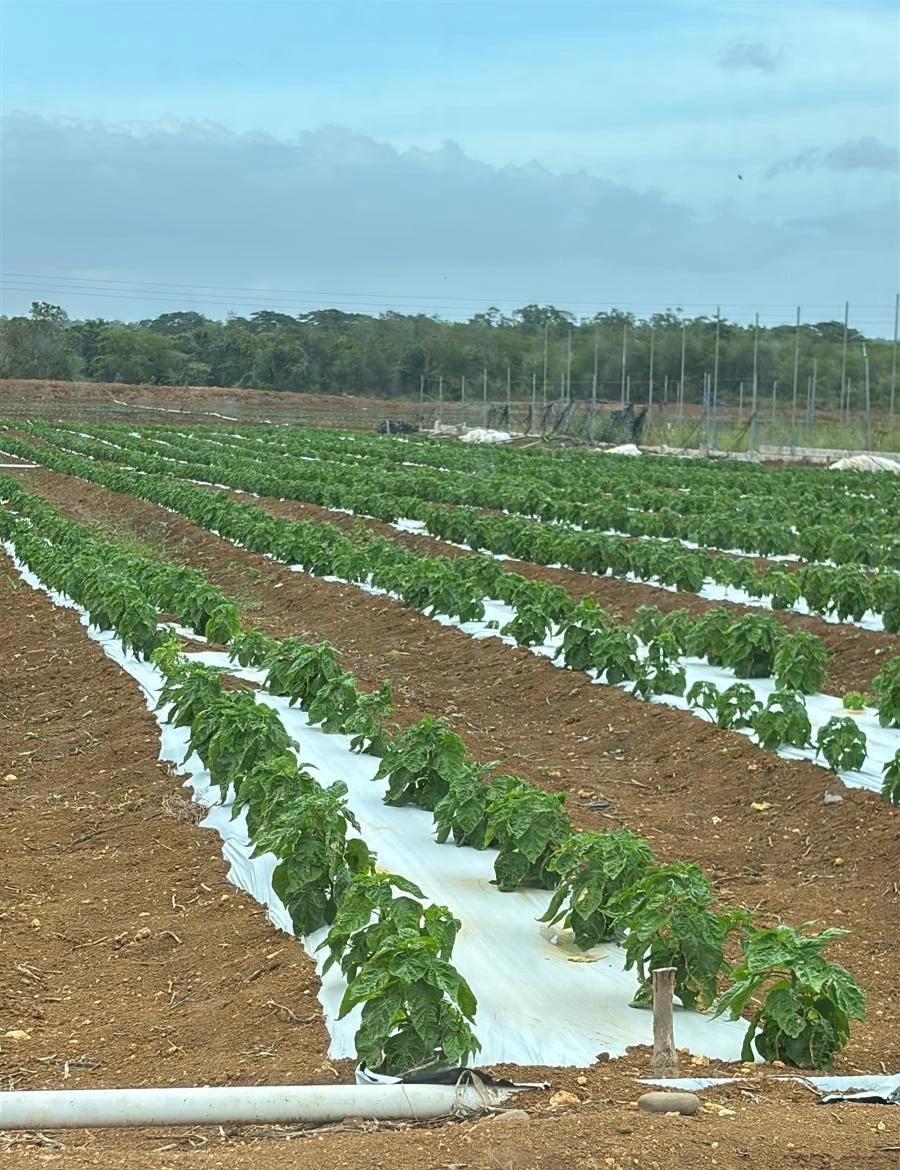
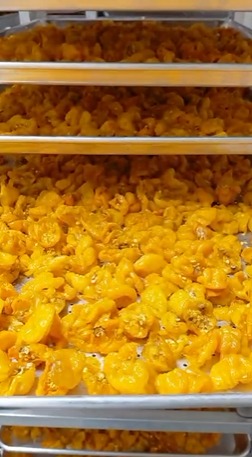
Source: ESL Farms (2026); MoAFM (Apr 2026).
Field
Field
Drying
Drying
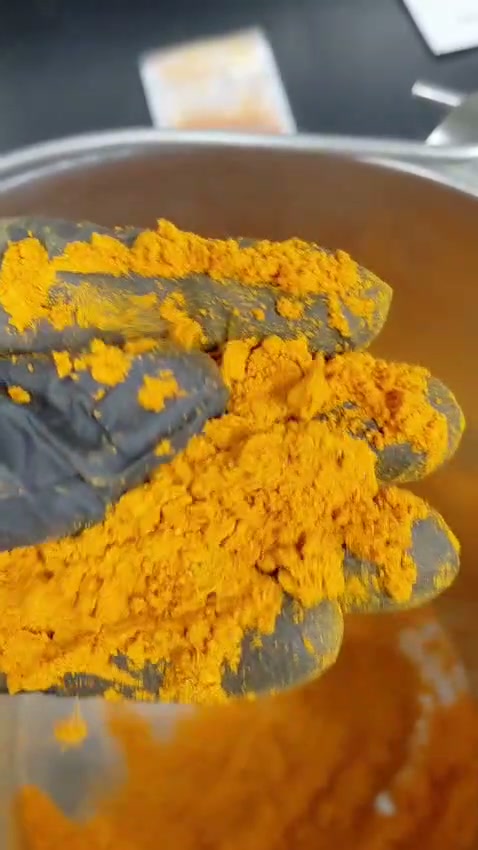
Powder
Powder
Vacuum-packed
Vacuum-packed
ESL Farms: field to powder (2026)
17
Slide 18 of 23#
Last mile · value

What is the last mile worth to your import bill?

Pepper, one acre (gross value before processing costs)

Fresh, sold to processor As tested powder Multiple
Scotch bonnet US$21,000 US$20,600–35,900 1.0–1.7×
Moruga red US$10,500 US$40,900–48,100 3.9–4.6×
  • Moruga powder roughly quadruples an acre's value
  • Scotch bonnet powder only pays at a tested, traceable premium, and that premium is what the last mile delivers

Yam: every 1% of the crop kept from loss ≈ 1,950 t ≈ US$8.4M a year

Your country's version: (tonnes saved × value) + (value added per acre × acres), set against your import bill

Source: Yield 5,364 kg/acre: Agro-Invest Hot Pepper Profile (Nov 2025). Processor prices J$280/lb (Scotch bonnet) and J$140/lb (red), 8% conversion: ESL Farms (2026). Powder: online bulk-pack prices, Sept 2026 (see pepper_economics.md). J$157.93/US$ (28 Sep 2026). Yam: UN Comtrade 2024; Gleaner (Mar 2026).
18
Slide 19 of 23#

Financing the last mile

Step Who could pay
Regional signal Public / regional institutions (already funded)
Drone scouting Fee-for-service; development finance for equipment for youth- and women-led operators
Field diagnosis and extension decision Ministries and extension services
Accredited laboratory Buyer or exporter for export certification; a blended facility for smallholders
Cold storage and packhouses Public and development partners (Essex Valley: GOJ, UK, CDB); fee-for-use
Farm roads Public works (70 roads in 2026–27)
Security and traceability JCF Agricultural Protection Branch; buyer-led record-keeping
Value-add processing Private capital; development-bank credit lines
19
Slide 20 of 23#

The last-mile reference model

  • Climate and security act on every step; records and test results travel with the produce
  • Every step uses technology and infrastructure already in the region
  • Every step can be run by youth- or women-led agribusinesses: drone scouting, field diagnostics, grading, cold-chain services, processing, farmer advisory
  • ESL provides two of these steps. Any accredited lab and any drone operator can run this model.
Two-track last-mile model: decision track above, physical track below forking to fresh market and/or processing
20
Slide 21 of 23#

Panel

  1. Stephen Jones, Managing Director, Environmental Solutions Limited
  2. Prof. Mark Wuddivira, Dean, Faculty of Agricultural Sciences and Sustainability, The UWI St. Augustine
  3. Mr. David Thomas, Agricultural Economist, Ministry of Agriculture, Fisheries and Mining
  4. Mrs. Sandra McLeish, Managing Director, Sankhard Company Limited (Springvale); Founder, Agro Cold Storage Logistics Limited
  5. Mr. Marvin Richards, Managing Director, The Reality Focus; Founder and CEO, Rush Alert Limited
  6. Mrs. Webb Lawrence, Senior Plant Health / Food Safety Officer, Rural Agricultural Development Authority (RADA)

Moderated by Leneka Terika Scott, Environmental Partnerships and Engagement Specialist, ESL

21
Slide 22 of 23#

What we're asking for

Within 12 months:

  • Name a pilot: one country, one value chain, one last-mile loop
  • Measure both: through the CARICOM Secretariat's Agricultural and Agro-Industrial Development Programme, put value funded per acre to COTED alongside the import-bill metric
  • Fund the steps: match each last-mile step to a funding source

[Commitments captured in the room: institution / 12-month action]

22
Slide 23 of 23#

Thank you

QR code: agweek2026.eslcaribbean.com/slidesagweek2026.eslcaribbean.com/slides

These slides and the film, plus the last-mile reference model, financing note, farmer adoption framework and country worksheet (posted after the session) Environmental Solutions Limited · 7 Hillview Avenue, Kingston 10 · (876) 978-9519 · info@eslcaribbean.com

Source: UN Comtrade (Jamaica, 2022–2025); CARICOM Secretariat; Caribbean Poultry Association (Oct 2025); CARICOM–WFP Dashboard; MoAFM (Apr, Sep 2026); CDB (Feb 2026); JIS (2026); Gleaner (Mar–Sep 2026); ESSJ; ESL Farms.
23
← → to move · Esc to exit