The Last Mile of Food Security
Using the region's new data tools to lower the food-import bill by capturing more value from the farm.
Film footage: ESL bioTECH (Denbigh 2022) and DJI Agriculture.
Food security is a purchasing-power target
Not "How many tonnes did this acre produce?" but
"How much of what this family eats did this acre pay for?"
The region now has eyes: the CARICOM–WFP Caribbean Real-Time Food Security Monitoring Dashboard, the Regional Risk Analysis mechanism and the E-Agriculture Strategy. It doesn't yet have hands: the layer that turns a regional signal into a decision on a specific farm, in time to matter. That's where value is won or lost. The last mile has two tracks: the decision on the farm, and the journey to the buyer, ending in the fresh market, processing, or both.
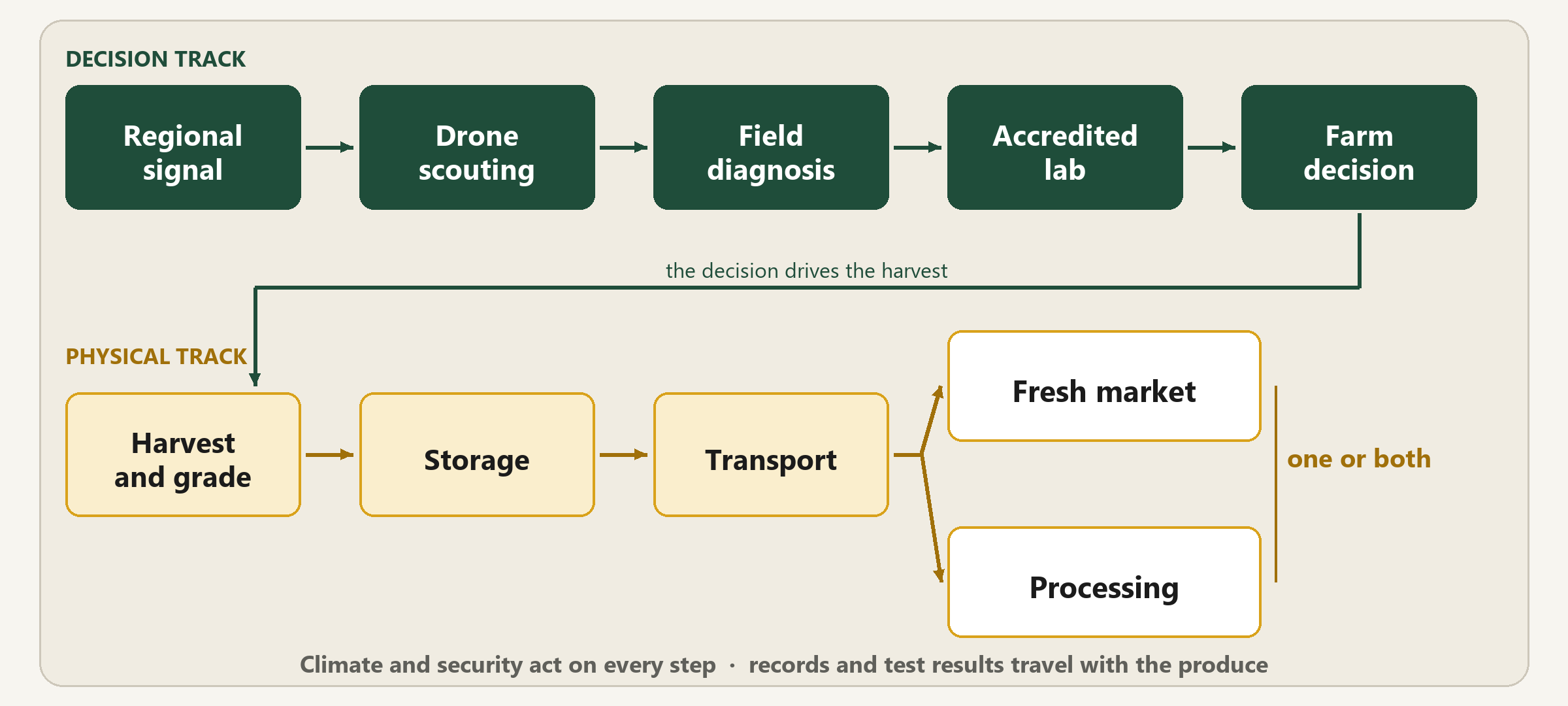
Every step uses technology and infrastructure already in the region, and every step can be run by youth- or women-led agribusinesses: drone scouting, field diagnostics, grading, cold-chain services, processing, farmer advisory. ESL provides two of these steps; any accredited lab and any drone operator can run this model.
Where value leaks after harvest
| 2026 reality | What the last mile adds | |
|---|---|---|
| Storage | J$9.4bn Essex Valley agro-processing and cold-storage facility handed over (Feb 2026): capacity for 22 containers | Grade and test before storage, so only sound produce takes up cold space |
| Transport | 70 farm roads to be rehabilitated in 2026–27 after Hurricane Melissa | Harvest timed to buyer and road access; the records travel with the load |
| Security | More than J$14 billion a year lost to agricultural theft; traceability is one of the Ministry's five response pillars | Recorded, tested lots with provenance from farm to point of sale |
| Climate | Production was heading for a record 930,000 t before Melissa hit 70,000+ farmers and fishers; drought followed in 2026 | Signal-driven harvest, storage and processing decisions |
Ministry of Agriculture, Fisheries and Mining and Caribbean Development Bank (Feb 2026); JIS, post-Melissa agriculture strategy (2026); MoAFM, Minister of State Witter (11 Sep 2026); Gleaner (Aug–Sep 2026).
What the last mile is worth
Pepper, one acre (gross value before processing costs)
| Fresh, sold to processor | As tested powder | |
|---|---|---|
| Scotch bonnet | US$21,000 | US$20,600–35,900 |
| Moruga red | US$10,500 | US$40,900–48,100 |
Yield 5,364 kg/acre: Agro-Invest Hot Pepper Profile (Nov 2025). Processor prices J$280/lb (Scotch bonnet) and J$140/lb (red), 8% conversion: ESL Farms (2026). Powder: online bulk-pack prices from named suppliers, Sept 2026. J$157.93/US$ (28 Sep 2026).
Yam, Trelawny's crop
Every 1% of Jamaica's yam crop kept from loss is about 1,950 t of food, worth roughly US$8.4 million a year at the 2024 export unit value.
The 2026 recovery is putting 65,000 kg of yam planting material into the ground. The last mile is what protects that investment.
UN Comtrade (Jamaica, HS 071430, 2024); Gleaner (Mar 2026); Ministry of Agriculture, Fisheries and Mining (30 Apr 2026).
Session outputs
These will be posted here after the session.
- Last-mile reference modelThe connective layer from regional signal to farm decision, for adaptation by member states
- Financing noteEach last-mile step matched to candidate funding sources
- Farmer adoption frameworkFor drone- and laboratory-supported field decisions
- Country worksheetWhat closing the last mile is worth to your own import bill