The Last Mile of Food Security
Using the region's new data tools to lower the food-import bill by capturing more value from the farm
Caribbean Week of Agriculture 2026 · The New F.A.C.E. of Caribbean Food Systems: Transformation and Resilience Ocean Coral Springs, Trelawny · Environmental Solutions Limited
Presenter notes · slide 1
The moderator welcomes the room (3 min) and hands over at 0:03.
For the first time, the region has eyes
- CARICOM–WFP Caribbean Real-Time Food Security Monitoring Dashboard: live since 10 April 2025 in 11 member states
- Regional Risk Analysis mechanism and E-Agriculture Strategy: adopted at COTED, CWA 2025
- Precision agriculture and digital skills are named E-Agriculture pillars
CWA 2026 is the first time these exist as ratified policy needing implementation.
Presenter notes · slide 2
Credit CARICOM first. [Confirm what the Regional Risk Analysis mechanism covers.]
Production rose. The bill held.
- CARICOM reports regional food production up about 24%, 2022 to late 2024
- The regional food-import bill is still more than US$6 billion a year
- The 25% reduction target moved from 2025 to 2030
Presenter notes · slide 3
"This is the central evidence: growing more, on its own, has not closed the gap." Call it "agri-food imports," not "the food bill."
The bill follows world prices, not our fields
- Wheat: value US$84M → US$51M (~40% down); tonnes down only 8%
- Corn: value US$122M → US$79M (35% down); tonnes down only 9%
Jamaica grows no wheat and very little corn. That US$76M fall came from world prices, not our farms.
We can't farm our way out of a grain bill. We can earn our way out of it.
The winnable substitution is mostly won
- Regional poultry output is heading for ~340,000 t, covering 80% of CARICOM's poultry consumption (2025)
- Much of what's left is corn, soy, wheat and red meat: scale-driven commodities that most of our land can't grow competitively. Where the region can (Guyana's rice, corn and soy; Belize's beef), regional trade is the answer.
Food security is a purchasing-power target
Not "How many tonnes did this acre produce?"
"How much of what this family eats did this acre pay for?"
A household is food-secure when the land it works generates enough value to command the food it consumes, whether it eats that food or sells what it grows and buys the rest.
A pepper turned into a finished product that earns an export premium funds far more imported nutrition than the same land in a staple it can never grow competitively.
Presenter notes · slide 6
This is the thesis the committee accepted. Say it with confidence. Bridge to CARICOM: the dashboard now tracks household access; this measures the farm end of the same question. It sits alongside the import-bill metric, not instead of it.
Floor and engine
| Staples floor | Value-add engine |
|---|---|
| Enough to eat through a hurricane or a closed border | Enough value per acre to buy the rest |
| Protects against trade shocks | Protects against local crop failure |
| Keeps you alive | Keeps you solvent |
Hurricane Melissa tested both. Real food security needs both.
The last mile: from signal to the buyer's hands
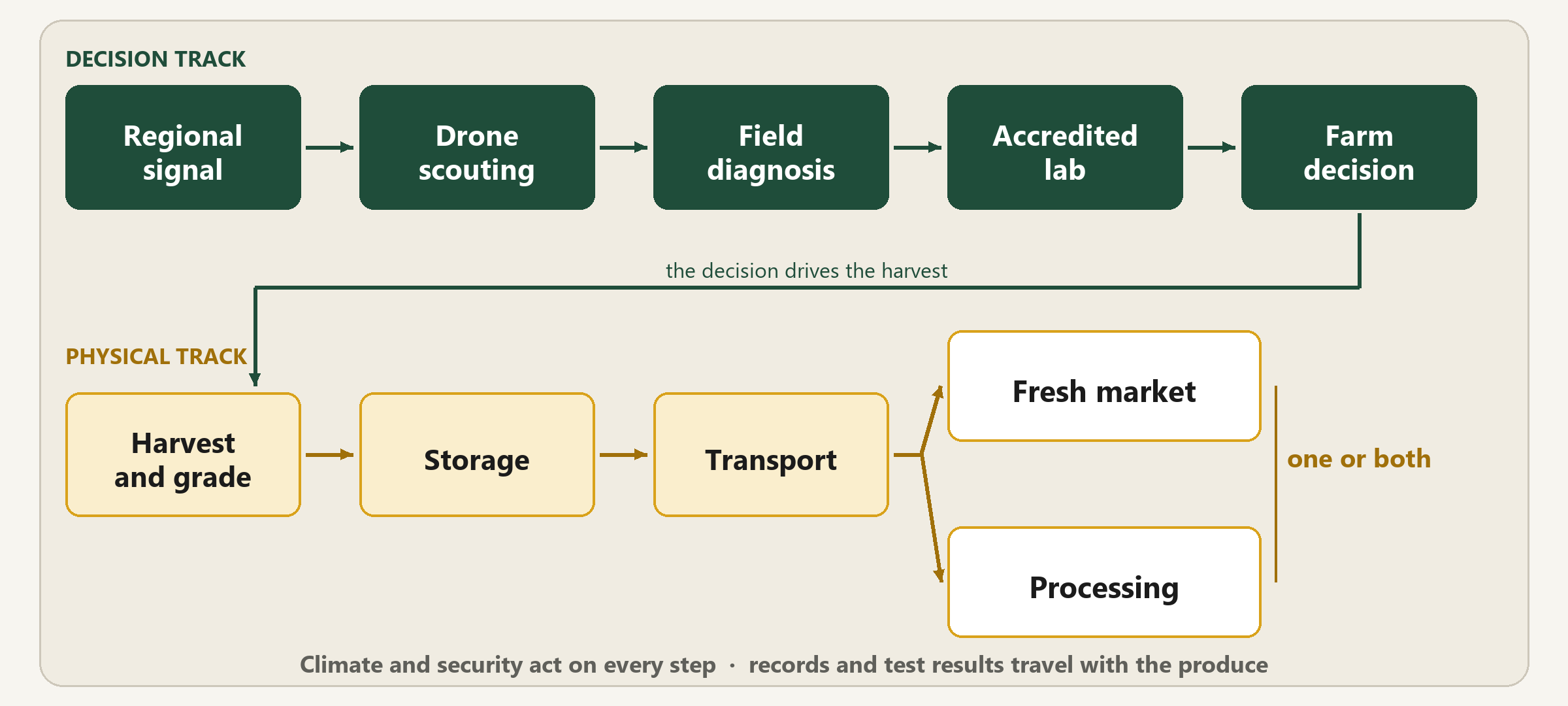
A signal in one capital doesn't change what a farmer plants, sprays or harvests this week, or whether the crop survives the trip to a buyer.
Climate and security act on every step. The records and test results that make the decision also travel with the produce.
Presenter notes · slide 8
This is where the audience's idea of the "last mile" (roads, storage, theft) meets the concept note's (data to decision). Both are the last mile; value is lost in either. The fork at the end matters: the best produce goes fresh, the rest is processed, and most farms will do both.
Where value leaks after harvest
| 2026 reality | What the last mile adds | |
|---|---|---|
| Storage | J$9.4bn Essex Valley agro-processing and cold-storage facility handed over (Feb 2026): capacity for 22 containers | Grade and test before storage, so only sound produce takes up cold space |
| Transport | 70 farm roads to be rehabilitated in 2026–27 after Melissa | Harvest timed to buyer and road access; the records travel with the load |
| Security | More than J$14 billion a year lost to agricultural theft; traceability is one of the Ministry's five response pillars | Recorded, tested lots with provenance from farm to point of sale |
| Climate | Production was heading for a record 930,000 t before Melissa hit 70,000+ farmers and fishers; drought followed in 2026 | Signal-driven harvest, storage and processing decisions |
Presenter notes · slide 9
The theft point links straight to food safety: the Ministry warns that stolen crops are often harvested soon after spraying and sold before they're safe. A recorded pre-harvest interval and a tested lot are the answer.
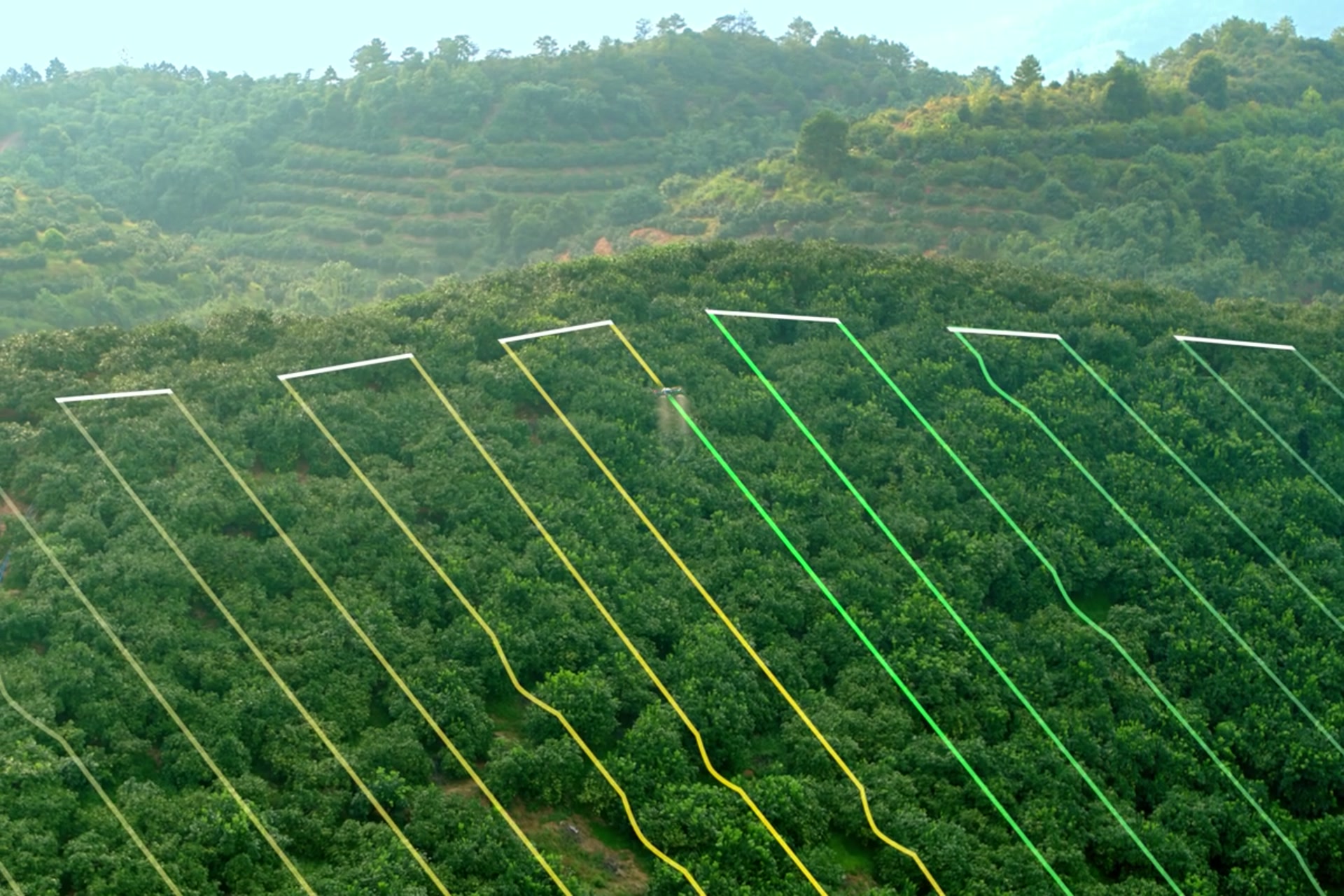
The last mile
Signal → Drone → Ground truth → Lab → Decision → Value
Presenter notes · slide 10
Introduce it in one line: "Here's what the last mile looks like, on Trelawny's own crop." The film carries a small "Illustrated" label; no further caveat is needed.
Yam: Trelawny's crop
- Jamaica's largest fresh-produce export
- ~195,000 t produced (2024); almost all exports leave as fresh tubers
- Trelawny is a top yam parish
Which tubers ship and which are lost is decided in the field, in the last mile.
Presenter notes · slide 11
If asked about 2025, the trade data may still be revised.
Rebuilding after Melissa: the 2026 recovery
- J$100 million yam recovery programme across Trelawny, Manchester, Clarendon, St Ann, St James, Hanover and Westmoreland
- 65,000 kg of yam heads (planting material) and fertiliser going out to farmers
- J$40 million to revive hot pepper: 80,000 seedlings
- More than 70,000 farmers hit by the storm; a recovery the Ministry calls data-driven
65,000 kg of planting material is going into the ground. Who checks it's clean? Who tells a farmer in time when a field goes wrong?

Presenter notes · slide 12
Credit the Ministry: this is the right investment. The last mile is what protects it. Yam nematodes spread through infested planting material (CABI).
Signal, drone, ground truth
- The region publishes the signal
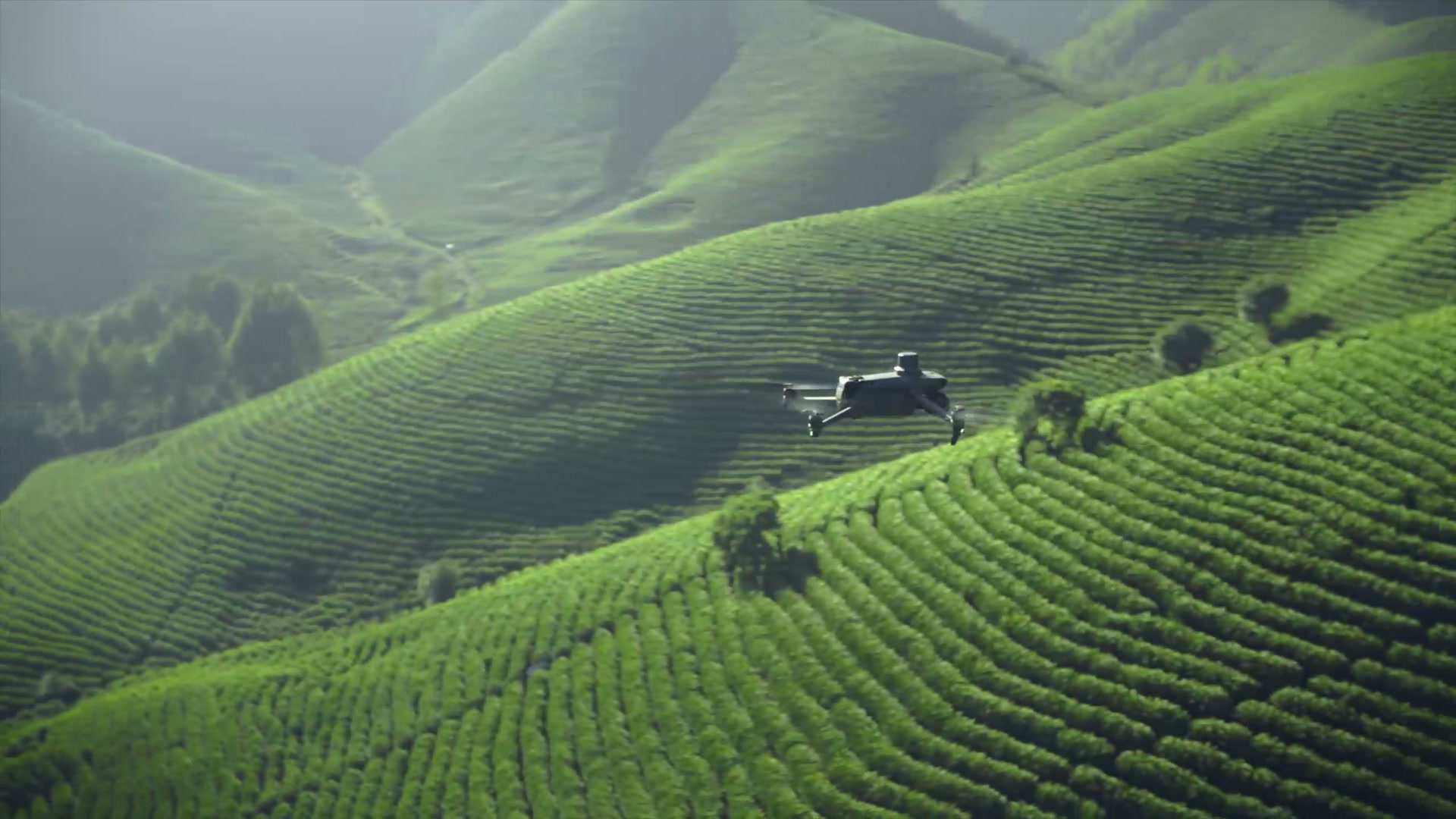
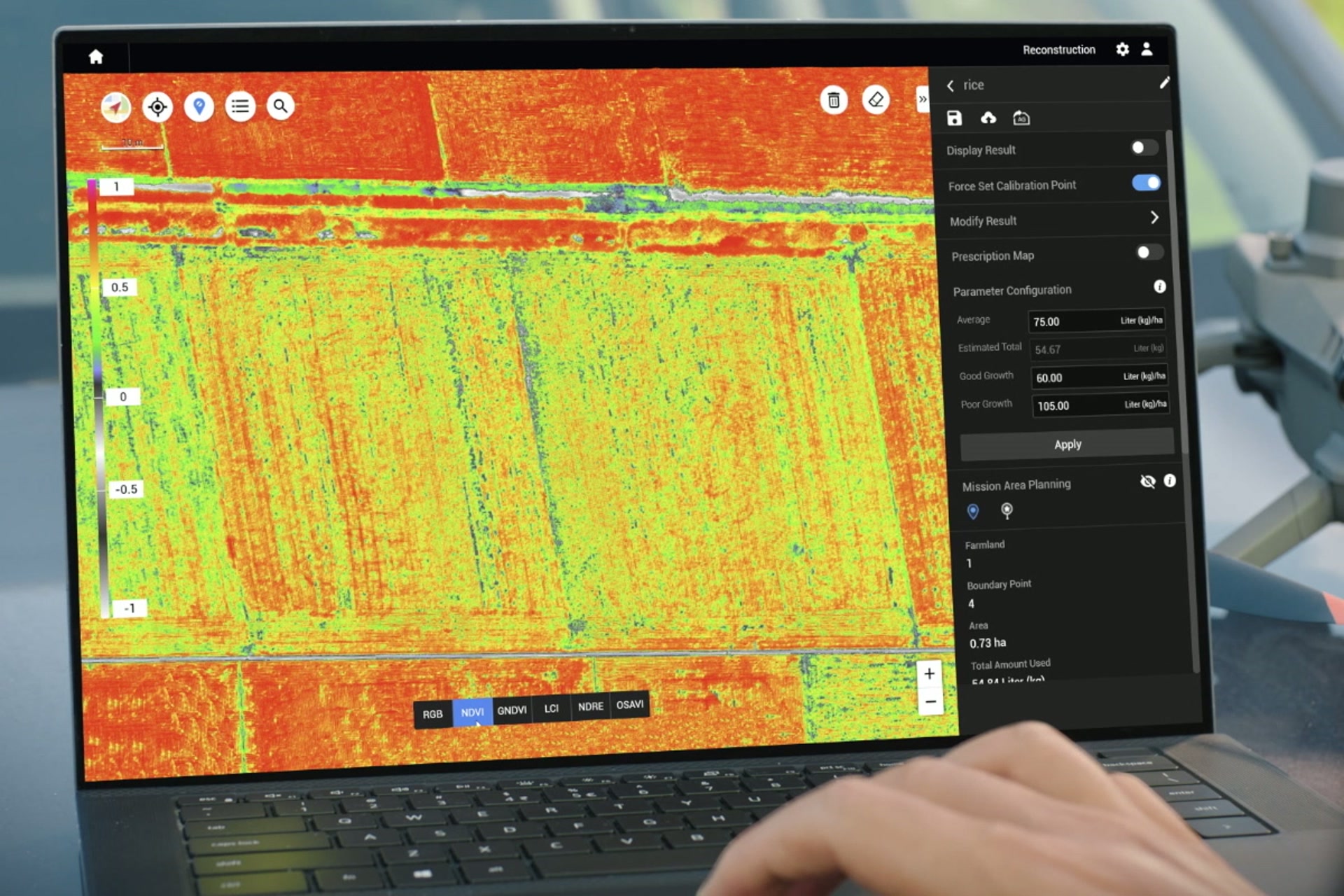
- The drone finds where: which hills, which rows
- The scout confirms what: vines, a test dig, where the planting setts came from
Laboratory confirmation
Test schedule
| Test | Why | Against |
|---|---|---|
| Nematode screen of setts and soil | "Yam burn" starts with infested planting material | Presence and count |
| Fungicide residue on tubers | Cut setts are treated before planting | Importing country's limit (US tolerance / EU MRL) |
| Moisture, microbiology (processed products) | Shelf life and buyer's certificate | Buyer specification |
| Nutrition panel (processed products) | Label claims | Label rules |
| Aflatoxins, ochratoxin A, Salmonella (chilli powder) | What export buyers test dried chilli for | EU / US limits for spices [confirm] |
Confirmation strong enough to act on, and a record an export buyer will accept. ESL's own pepper powder has just been through this: ESL and Bureau of Standards Jamaica analysis.
Presenter notes · slide 14
[Confirm each test is within ESL's ISO/IEC 17025 scope; mark any others "referred to partner lab".] No accreditation mark on the slide.
The farm-level decision
Prepared for the extension officer: - Plant only screened setts; treat with a registered product at the label rate - Record the pre-harvest interval before harvest: stolen or rushed produce is often sold before it is safe - Grade at harvest: export-grade → fresh market; off-grade → processing; most farms will do both
The dashboard's signal, turned into an instruction a farmer can act on this week.
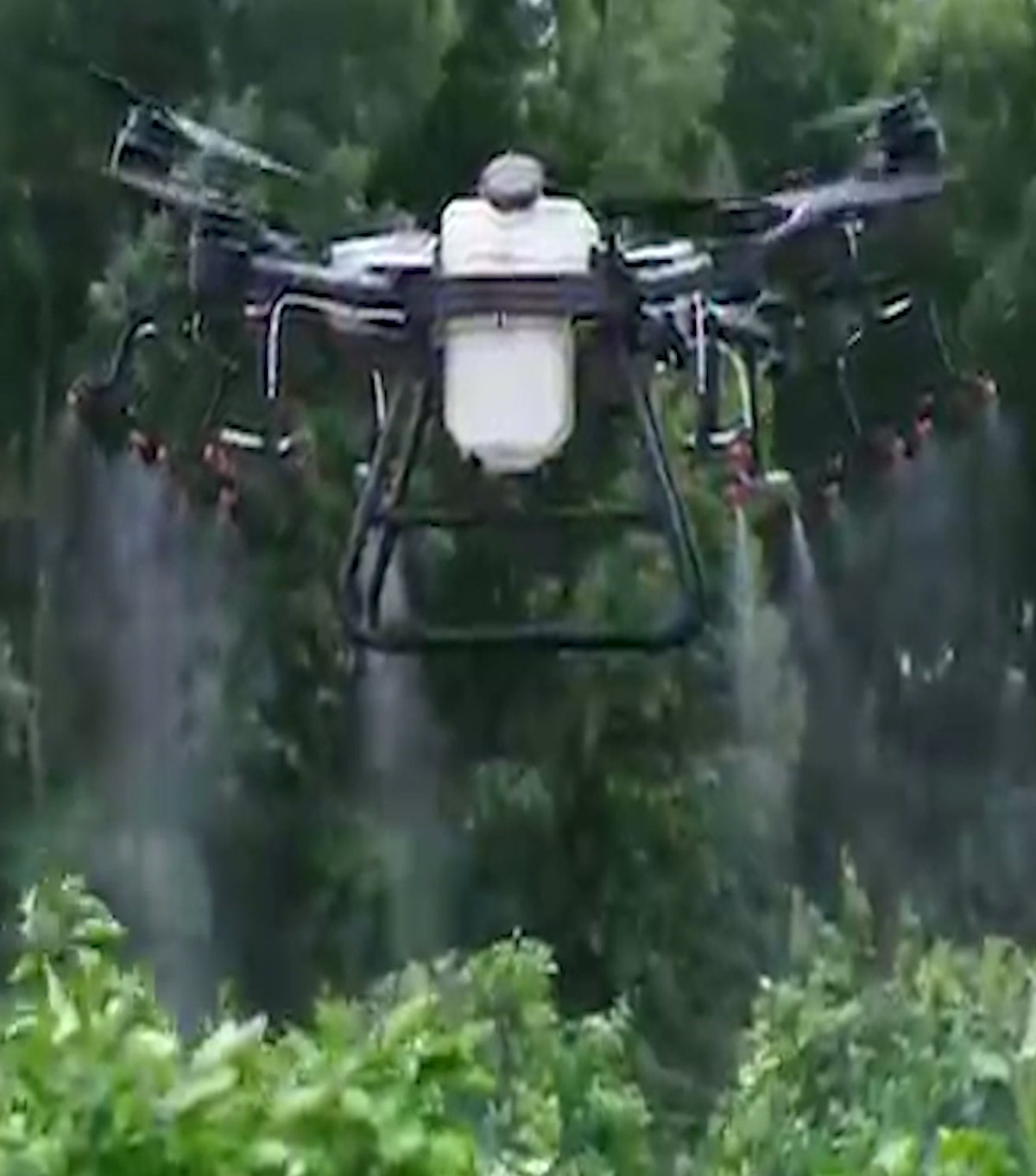
Capturing the value: fresh, processed, or both
After harvest and grading, the physical track forks: - Fresh market: export-grade yam earns its premium fresh, if storage and transport hold its quality - Processing: off-grade, cut, small and storm-damaged tubers become frozen peeled yam and 100% Jamaican yellow yam flour: gluten-free, traceable, tested - Both: most farms will run both paths from the same harvest. Processing turns what would be lost in storage or transport into product.
Several best-selling UK "pounded yam" powders are mostly potato. A tested Jamaican yam flour is a premium product in a market that already exists.
The last mile, already working on pepper
| Step | ESL Farms, Clarendon: Scotch bonnet and Moruga red |
|---|---|
| Signal | [in place / being connected] |
| Drone scouting | [in place / being connected] |
| Field diagnosis | [in place / being connected] |
| Accredited lab | Done: ESL and Bureau of Standards Jamaica analysis just completed |
| Farm decision | [in place / being connected] |
| Value (processing path) | Done: vacuum-packed powder; bulk-sale samples with buyers now |
The Ministry is distributing 80,000 hot pepper seedlings to farmers in 2026. The last mile is what turns that crop into this.
Presenter notes · slide 17
Only mark a step "in place" if it is running today; otherwise "being connected". Honest gaps make the rest believable. Don't describe the drying setup; it's proprietary. If asked: "That part's ours. What matters for the model is the testing." This is the concept note's own example made real: "a pepper turned into a finished product that earns an export premium."
What is the last mile worth to your import bill?
Pepper, one acre (gross value before processing costs)
| Fresh, sold to processor | As tested powder | Multiple | |
|---|---|---|---|
| Scotch bonnet | US$21,000 | US$20,600–35,900 | 1.0–1.7× |
| Moruga red | US$10,500 | US$40,900–48,100 | 3.9–4.6× |
- Moruga powder roughly quadruples an acre's value
- Scotch bonnet powder only pays at a tested, traceable premium, and that premium is what the last mile delivers
Yam: every 1% of the crop kept from loss ≈ 1,950 t ≈ US$8.4M a year
Your country's version: (tonnes saved × value) + (value added per acre × acres), set against your import bill
Presenter notes · slide 18
Say "before processing costs" out loud. The honest Scotch bonnet result is the strongest argument for the last mile: without testing and traceability it's a commodity; with them it earns the premium. The Ministry's yield is the average for Scotch bonnet and West Indian Red; Moruga may differ [replace with ESL's Moruga yield if known]. Only promise a country worksheet if ESL will send it.
Financing the last mile
| Step | Who could pay |
|---|---|
| Regional signal | Public / regional institutions (already funded) |
| Drone scouting | Fee-for-service; development finance for equipment for youth- and women-led operators |
| Field diagnosis and extension decision | Ministries and extension services |
| Accredited laboratory | Buyer or exporter for export certification; a blended facility for smallholders |
| Cold storage and packhouses | Public and development partners (Essex Valley: GOJ, UK, CDB); fee-for-use |
| Farm roads | Public works (70 roads in 2026–27) |
| Security and traceability | JCF Agricultural Protection Branch; buyer-led record-keeping |
| Value-add processing | Private capital; development-bank credit lines |
Presenter notes · slide 19
A proposal for the panel's development-finance seat to react to. It becomes the financing note.
The last-mile reference model
- Climate and security act on every step; records and test results travel with the produce
- Every step uses technology and infrastructure already in the region
- Every step can be run by youth- or women-led agribusinesses: drone scouting, field diagnostics, grading, cold-chain services, processing, farmer advisory
- ESL provides two of these steps. Any accredited lab and any drone operator can run this model.

Presenter notes · slide 20
[Optional, if true: "ESL will not bid to run the pilot proposed today."]
Panel
- [Name] · CARICOM / IICA technical lead
- [Name] · Agricultural economist
- [Name] · National extension leader
- [Name] · Development finance
- [Name] · Youth- or women-led agribusiness operator
Moderator: [Name]
What we're asking for
Within 12 months: - Name a pilot: one country, one value chain, one last-mile loop - Measure both: through the CARICOM Secretariat's Agricultural and Agro-Industrial Development Programme, put value funded per acre to COTED alongside the import-bill metric - Fund the steps: match each last-mile step to a funding source
[Commitments captured in the room: institution / 12-month action]
Thank you
agweek2026.eslcaribbean.com/sessionLast-mile reference model · financing note · farmer adoption framework · your country's worksheet [published by: date] Environmental Solutions Limited · [contact]